Regulatory Requirements
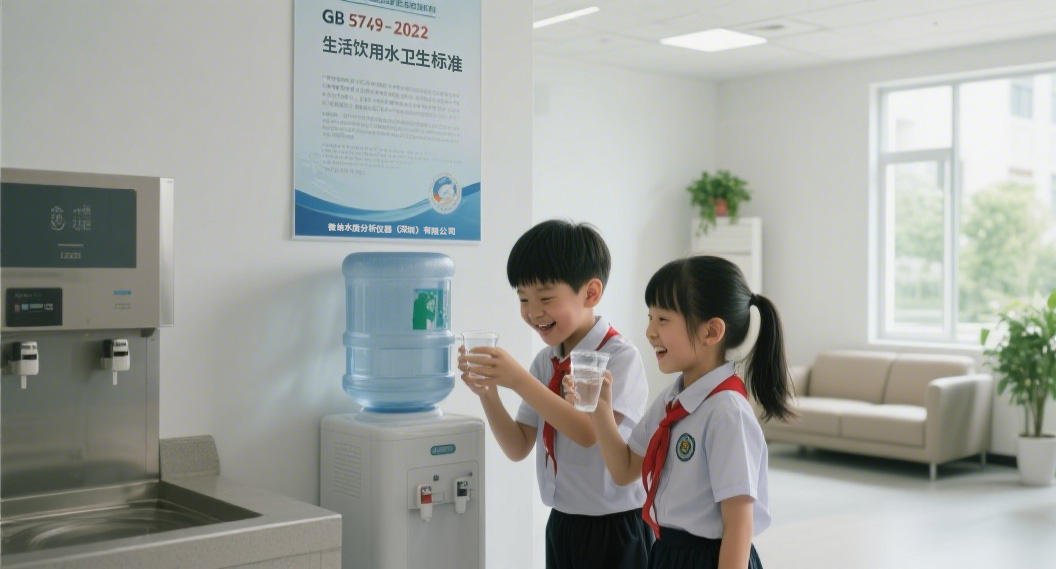
GB 5749-2022 Standards for Drinking Water Quality covers the entire process of drinking water supply, puts forward control requirements for water sources, water treatment, water transmission, water storage and tap water, and further strengthens the whole-process management and control of water supply from source to tap.
Drinking water quality testing covers urban water supply and rural water supply, including centralized water supply, small-scale centralized water supply, secondary water supply, finished water and tap water. In the draft for comments of the mandatory national standard GB 5749 Standards for Drinking Water Quality, the water quality evaluation requirements for urban and rural water supply are unified. Due to the limitations of water sources and water purification technologies, transitional requirements are retained for 4 indicators including colony count, fluoride, nitrate (calculated as N) and turbidity, and the testing requirements for disinfectants under different disinfection methods are further clarified.
For rural water supply projects, efforts should be made to continuously improve the water quality assurance level, and actively implement the water supply projects serving a population of over 10,000 with a water supply capacity of over 1,000 tons per day and the water supply projects serving a population of over 1,000. Water supply projects serving a population of over 10,000 with a water supply capacity of over 1,000 tons per day shall be fully equipped with purification and disinfection facilities and equipment. Water supply projects serving a population of over 1,000 with surface water or unstable groundwater as water sources shall be equipped with purification facilities and equipment; all water supply projects serving a population of over 1,000 shall be equipped with disinfection equipment. Strengthen water quality testing and monitoring to continuously improve the water quality assurance level.
Relevant Standards
GB 5749-2022 Standards for Drinking Water Quality
GB/T 5750-2023 Standard Examination Methods for Drinking Water
SL 310-2019 Technical Specifications for Rural Water Supply Projects
T/CHES18-2018 Evaluation Criteria for Rural Drinking Water Safety
T/CECS 493-2017 Technical Specification for Automatic Monitoring and Control of Rural Water Supply Projects
GB 17051-2025 Hygienic Specifications for Secondary Water Supply Facilities
CJJ/T 271-2017 Technical Standard for Online Monitoring of Urban Water Supply Quality
T/WSJD 10-2020 Technical Specification for Online Monitoring of Drinking Water Quality
HJ 589-2021 Technical Specifications for Emergency Monitoring of Sudden Environmental Events
Guidelines for Compiling Emergency Plans for Sudden Environmental Events in Centralized Surface Water Drinking Water Sources
……
Routine Examination Items and Limits of Drinking Water Quality
| Indicator Category | Indicator Name | Limit / Requirement | Unit |
| Microbiological Indicators | Total Coliforms | Not detectable | MPN/100mL or CFU/100mL |
| Escherichia coli | Not detectable | MPN/100mL or CFU/100mL |
| Colony Count | ≤100 | CFU/mL |
| Toxicological Indicators | Arsenic | ≤0.01 | mg/L |
| Cadmium | ≤0.005 | mg/L |
| Chromium (Hexavalent) | ≤0.05 | mg/L |
| Lead | ≤0.01 | mg/L |
| Mercury | ≤0.001 | mg/L |
| Cyanide | ≤0.05 | mg/L |
| Fluoride | ≤1.0 | mg/L |
| Nitrate (calculated as N) | ≤10 | mg/L |
| Trichloromethane | ≤0.06 | mg/L |
| Bromodichloromethane | ≤0.1 | mg/L |
| Dibromochloromethane | ≤0.06 | mg/L |
| Tribromomethane | ≤0.1 | mg/L |
| Trihalomethanes (sum of ratio of total amount) | ≤1 | — |
| Dichloroacetic Acid | ≤0.05 | mg/L |
| Trichloroacetic Acid | ≤0.1 | mg/L |
| Bromate | ≤0.01 | mg/L |
| Chlorite | ≤0.7 | mg/L |
| Chlorate | ≤0.7 | mg/L |
| Sensory Characteristics and General Chemical Indicators | Colority | ≤15 | Degree |
| Turbidity | ≤1 | NTU |
| Odor and Taste | No abnormal odor or taste | — |
| Visible Substances | None | — |
| pH | 6.5–8.5 | — |
| Aluminum | ≤0.2 | mg/L |
| Iron | ≤0.3 | mg/L |
| Manganese | ≤0.1 | mg/L |
| Copper | ≤1.0 | mg/L |
| Zinc | ≤1.0 | mg/L |
| Chloride | ≤250 | mg/L |
| Sulfate | ≤250 | mg/L |
| Total Dissolved Solids | ≤1000 | mg/L |
| Total Hardness (calculated as CaCO₃) | ≤450 | mg/L |
| Permanganate Index (calculated as O₂) | ≤3 | mg/L |
| Ammonia (calculated as N) | ≤0.5 | mg/L |
| Disinfectant Indicators | Free Chlorine | Residual in finished water ≥0.3; Residual in tap water ≥0.05 | mg/L |
| Total Chlorine | Residual in finished water ≥0.5; Residual in tap water ≥0.05 | mg/L |
| Ozone | Residual in finished water ≥0.3 | mg/L |
| Chlorine Dioxide | Residual in finished water ≥0.1; Residual in tap water ≥0.02 | mg/L |
Note:
① NTU in the table refers to Nephelometric Turbidity Unit.
② Special cases include limitations of water sources and other situations.
③ CFU refers to Colony-Forming Unit.
④ This table only lists routine testing items. For other items, please refer to relevant standards or contact VVNA customer service.